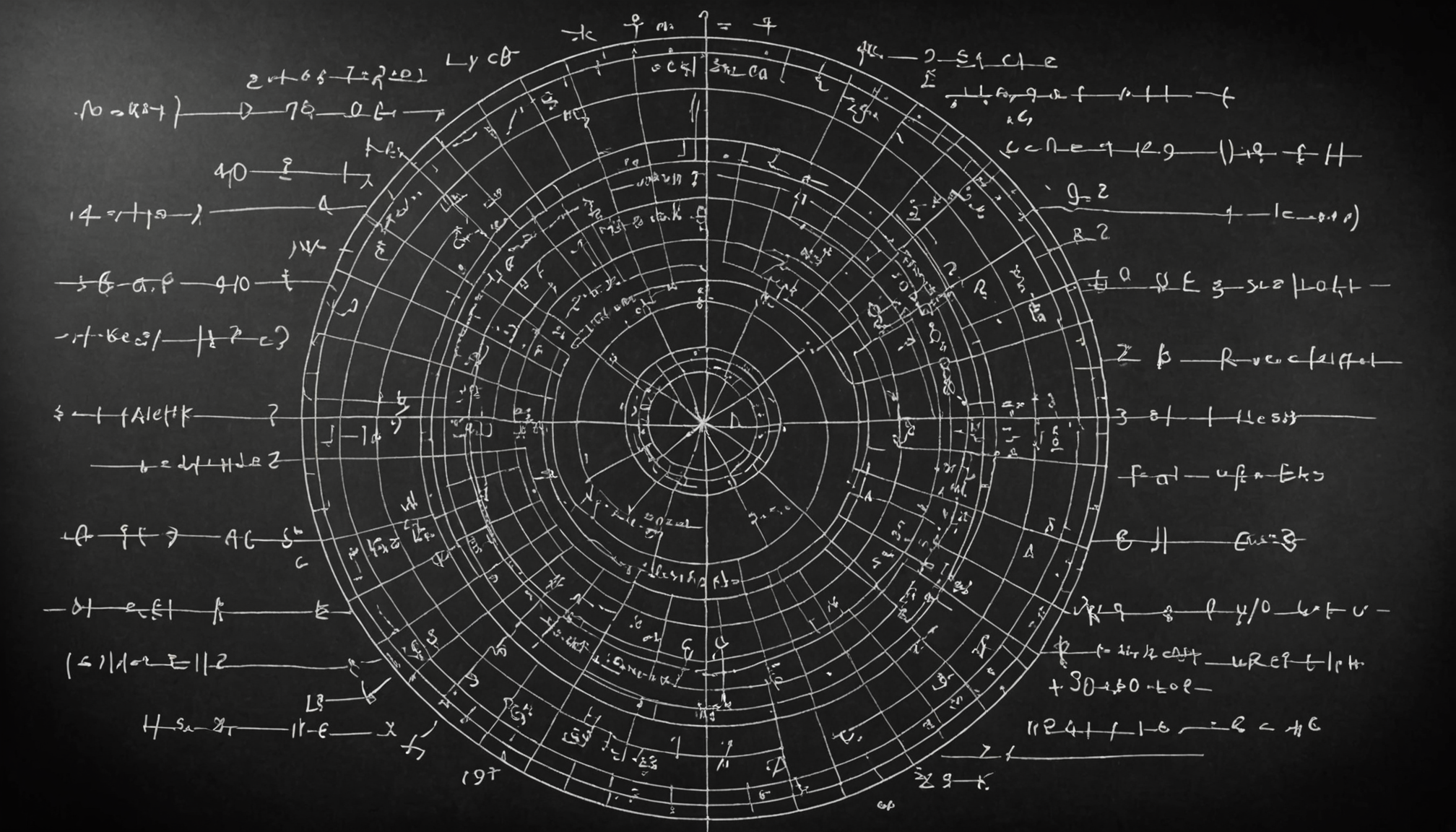
Mathematics is often seen as a realm of certainty, a language of numbers and symbols that provides clear answers to complex problems. Yet, beneath this surface of precision lies a rich tapestry of philosophical inquiry that questions the very foundations of mathematical thought. What does it mean for something to be mathematically true? How do we know that our mathematical constructs correspond to anything real? These questions have intrigued philosophers for centuries, leading to a vibrant dialogue about the nature of mathematics itself.
At its core, the philosophy of mathematics grapples with the essence of mathematical objects, the validity of mathematical reasoning, and the implications of mathematical truths. It invites us to consider not just how mathematics works, but why it works in the way that it does. This exploration is not merely academic; it has profound implications for how we understand the world around us. As we delve into this philosophical landscape, we will encounter various perspectives that illuminate the intricate relationship between mathematics and reality, logic, and even ethics.
In exploring the intriguing intersections of philosophy and mathematics, one might find the article on the philosophy of mathematics particularly enlightening. It delves into the foundational questions surrounding mathematical truths and their existence, offering insights that resonate with both philosophers and mathematicians alike. For a broader understanding of how to effectively communicate such complex ideas, you might also find this article on podcasting strategies useful: Clever Ways to Get Your Podcast Heard.
The Relationship Between Mathematics and Reality
The relationship between mathematics and reality is a complex and often contentious issue. On one hand, mathematics appears to be an abstract construct, a system of symbols and rules that we create to make sense of the world. On the other hand, it seems to describe aspects of reality with remarkable accuracy. Consider the way mathematics underpins the laws of physics: from the trajectory of a falling apple to the orbits of planets, mathematical equations provide a framework for understanding natural phenomena. This duality raises questions about whether mathematics is merely a tool we use or if it has a more profound connection to the fabric of reality itself.
One perspective is that mathematics is a universal language that transcends cultural and temporal boundaries. The Pythagorean theorem, for instance, holds true regardless of where or when it is applied. This universality suggests that mathematical truths exist independently of human thought, leading some to argue for a realist interpretation of mathematics. However, others contend that while mathematics may describe reality effectively, it does not necessarily imply that mathematical entities exist outside our minds. This ongoing debate invites us to reflect on how we perceive and interact with the world through the lens of mathematics.
The Role of Logic in Mathematics

Logic serves as the backbone of mathematical reasoning, providing the rules and structures that govern how we derive conclusions from premises. In mathematics, logical principles help ensure that our arguments are sound and our conclusions valid. For example, if we accept that all humans are mortal and that Socrates is a human, we can logically conclude that Socrates is mortal. This deductive reasoning is fundamental to mathematical proofs, where each step must follow logically from the previous one.
However, the relationship between logic and mathematics is not always straightforward. The advent of non-Euclidean geometries in the 19th century challenged traditional notions of logical consistency in mathematics. These new geometries demonstrated that multiple logical frameworks could coexist, each yielding different yet valid mathematical truths. This realization prompted philosophers like Kurt Gödel to explore the limits of formal systems through his incompleteness theorems, which revealed that no consistent system can prove all truths within its own framework. Thus, while logic is essential to mathematics, it also opens up questions about the completeness and consistency of mathematical systems themselves.
The Debate on the Existence of Mathematical Objects

One of the most intriguing debates in the philosophy of mathematics centers around the existence of mathematical objects. Are numbers, shapes, and other mathematical entities real in some sense, or are they mere abstractions? This question has led to various philosophical positions, each offering a different perspective on the nature of mathematical existence.
Mathematical Platonism posits that mathematical objects exist independently of human thought; they inhabit a non-physical realm akin to Plato’s world of forms. According to this view, when mathematicians discover new truths, they are uncovering pre-existing realities rather than creating them. In contrast, nominalism denies the existence of abstract mathematical entities altogether, arguing that numbers are simply names or labels we use to describe collections or patterns in the world. This perspective emphasizes the pragmatic utility of mathematics without committing to any metaphysical claims about its existence.
In exploring the intricate connections between mathematics and philosophical thought, one can find valuable insights in the article on the philosophy of mathematics available at Philosophy for Lunch. This resource delves into various perspectives on how mathematical truths are understood and the implications they hold for our broader understanding of reality. Engaging with such discussions can deepen our appreciation of the foundational questions that underpin mathematical concepts and their applications.
The Nature of Mathematical Truth
| Topic | Definition |
|---|---|
| Philosophy of Mathematics | The branch of philosophy that studies the assumptions, foundations, and implications of mathematics. |
| Mathematical Realism | The view that mathematical entities exist independently of the human mind and are discovered rather than invented. |
| Mathematical Platonism | A form of mathematical realism that posits the existence of abstract mathematical objects in a non-physical realm. |
| Mathematical Nominalism | The view that mathematical objects do not exist independently of the human mind and are merely useful fictions. |
| Intuitionism | A philosophy of mathematics that holds that mathematical knowledge is derived from intuition and that mathematical objects are mental constructions. |
The nature of mathematical truth is another area ripe for philosophical exploration. What does it mean for a mathematical statement to be true? In traditional logic, truth is often defined in terms of correspondence with reality; a statement is true if it accurately describes some aspect of the world. However, in mathematics, truth can take on a different character. A statement like “2 + 2 = 4” is considered true not because it corresponds to an observable reality but because it follows from accepted axioms and definitions within a given mathematical system.
This raises questions about the objectivity and universality of mathematical truth. If mathematical truths are derived from axioms that are themselves subject to choice and interpretation, can we claim that they hold universally? Some philosophers argue that mathematical truths are contingent upon human conventions and practices, while others maintain that they possess an objective quality independent of our beliefs or perceptions. This tension between subjective interpretation and objective truth continues to fuel philosophical discussions about the foundations of mathematics.
The Philosophy of Mathematical Platonism
Mathematical Platonism offers a compelling perspective on the existence and nature of mathematical objects. According to this view, numbers and other mathematical entities exist in an abstract realm that is timeless and unchanging. Just as Plato envisioned a world of ideal forms beyond our physical reality, Platonists argue that mathematical truths exist independently of human thought and discovery. When mathematicians engage in their work, they are not inventing new concepts but rather uncovering truths that have always existed.
This perspective has significant implications for how we understand mathematical practice. If mathematical objects exist independently, then mathematicians are akin to explorers charting a landscape that exists outside their minds. This view lends an air of objectivity to mathematics; it suggests that there are right answers waiting to be discovered rather than merely constructed by human agreement. However, critics argue that this position raises further questions about how we access this abstract realm and whether our understanding can ever be complete or accurate.
The Philosophy of Mathematical Nominalism
In stark contrast to Platonism stands nominalism, which challenges the notion that abstract mathematical objects exist independently of human thought. Nominalists argue that numbers and other mathematical entities are simply linguistic constructs—names we use to describe collections or patterns in our experiences rather than entities with independent existence. For instance, when we say “three apples,” we are not referring to an abstract concept of “three” but rather to a specific collection of apples.
Nominalism emphasizes the pragmatic aspects of mathematics; it views mathematical language as a useful tool for organizing our experiences rather than as a reflection of an objective reality. This perspective invites us to consider how mathematics functions in practice: it is a system developed by humans to solve problems and make sense of patterns in nature. While nominalism may seem less grand than Platonism’s vision of an eternal realm of forms, it offers a grounded approach that aligns closely with our everyday experiences.
The Philosophy of Mathematical Intuitionism
Mathematical intuitionism presents yet another perspective on the nature of mathematics and its foundations. Founded by mathematician L.E.J. Brouwer in the early 20th century, intuitionism posits that mathematics is fundamentally rooted in human intuition and mental constructions rather than in an external reality or abstract entities. According to this view, mathematical truths are not discovered but created through our cognitive processes.
Intuitionists reject classical logic’s reliance on the law of excluded middle—the principle stating that every statement is either true or false—arguing instead for a more constructive approach to mathematics. For example, rather than asserting that there exists an infinite set without explicitly constructing one, intuitionists would require a method for demonstrating its existence through finite processes. This emphasis on constructive proof reflects a deeper philosophical commitment to understanding mathematics as an activity grounded in human experience rather than as an exploration of an abstract realm.
The Role of Mathematics in Scientific Inquiry
Mathematics plays an indispensable role in scientific inquiry, serving as both a language and a tool for understanding complex phenomena. From formulating hypotheses to analyzing data and modeling systems, mathematics provides scientists with a framework for articulating their ideas and testing their theories against empirical evidence. The precision and rigor inherent in mathematical reasoning allow scientists to draw meaningful conclusions from their observations.
Moreover, mathematics often reveals patterns and relationships that might otherwise go unnoticed in empirical data alone. For instance, statistical methods enable researchers to discern trends within large datasets, while calculus allows physicists to model dynamic systems with precision. This interplay between mathematics and science underscores not only the utility of mathematical tools but also raises questions about the nature of scientific knowledge itself: Is scientific truth merely a reflection of mathematical structures, or does it extend beyond them into realms not easily captured by numbers?
The Connection Between Mathematics and Ethics
The connection between mathematics and ethics may not be immediately apparent; however, both fields grapple with questions about truth, certainty, and human understanding. Just as mathematicians seek objective truths within their systems, ethicists strive for moral principles that can guide human behavior across diverse contexts. This parallel invites us to consider how mathematical reasoning might inform ethical decision-making.
For example, utilitarianism—a consequentialist ethical theory—often employs quantitative measures to evaluate actions based on their outcomes for overall happiness or well-being. In this sense, mathematics provides a framework for assessing ethical dilemmas by quantifying potential consequences and guiding individuals toward decisions that maximize positive outcomes. However, this reliance on numerical calculations raises ethical questions about reducing complex moral issues to mere calculations: Can human experiences truly be captured by numbers alone?
The Future of the Philosophical Foundations of Mathematics
As we look toward the future of the philosophical foundations of mathematics, several intriguing questions emerge regarding its evolution in light of technological advancements and new scientific discoveries. The rise of artificial intelligence and machine learning has already begun reshaping how we approach problem-solving within mathematics; algorithms can now generate proofs or identify patterns at speeds unimaginable just decades ago.
This technological shift prompts us to reconsider traditional philosophical debates surrounding mathematics: If machines can produce valid proofs or discover new mathematical truths autonomously, what does this mean for our understanding of creativity and intuition in mathematics? Furthermore, as interdisciplinary fields such as computational biology or quantum computing continue to blur boundaries between disciplines, how might these developments influence our philosophical perspectives on both mathematics and its relationship with reality?
In conclusion, exploring the philosophical foundations of mathematics reveals a rich landscape filled with questions about existence, truth, and our understanding of reality itself. Whether through Platonism’s ideal forms or nominalism’s pragmatic constructs, each perspective offers unique insights into how we engage with this fascinating discipline. As we continue navigating these philosophical waters—especially amid rapid technological advancements—we remain challenged not only by what we know but also by what remains uncertain in our quest for understanding through mathematics.
FAQs
What is the philosophy of mathematics?
The philosophy of mathematics is the branch of philosophy that studies the assumptions, foundations, and implications of mathematics. It explores questions about the nature of mathematical objects, the relationship between mathematics and reality, and the methods and reasoning used in mathematics.
What are the main areas of inquiry in the philosophy of mathematics?
The main areas of inquiry in the philosophy of mathematics include the nature of mathematical objects (such as numbers and sets), the epistemology of mathematics (how we come to know mathematical truths), the ontology of mathematics (the existence of mathematical objects), and the relationship between mathematics and the physical world.
What are some of the major philosophical theories of mathematics?
Some major philosophical theories of mathematics include Platonism, which holds that mathematical objects exist independently of human thought; formalism, which views mathematics as a formal system of symbols and rules; and constructivism, which emphasizes the role of human construction and intuition in mathematics.
How does the philosophy of mathematics relate to the practice of mathematics?
The philosophy of mathematics informs the practice of mathematics by raising questions about the nature of mathematical objects, the validity of mathematical reasoning, and the foundations of mathematical theories. It also influences debates about the use of mathematical methods in science and the role of mathematics in understanding the world.
What are some contemporary issues in the philosophy of mathematics?
Contemporary issues in the philosophy of mathematics include the nature of mathematical truth, the status of mathematical objects, the implications of developments in mathematical logic and set theory, and the relationship between mathematics and other areas of inquiry such as physics and computer science.